Outer Dowsing Offshore Wind


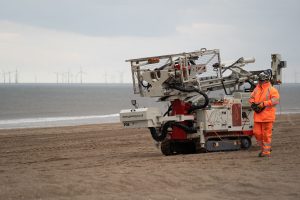
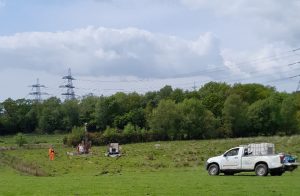
THE PROJECT Geotechnical Engineering pioneer rig manoeuvring to borehole location along 90m wide, 55km proposed cable corridor

Located on the East Coast of England along Wash northern bank, near Ingoldmells, Skegness and Boston towns. The Ground Investigation was required to determine the ground and groundwater conditions along a 90m wide, 55km proposed cable corridor between landfall location South of Anderby Creek and a connection point at Weston Marsh.

The onshore cables would be installed through a combination of trenching and horizontal directional drilling to cross existing infrastructure assets, a targeted ground investigation was required at multiple sites of interest along the cable route.

GT R4 limited engaged Geotechnical Engineering to fulfil the role of Principal Contractor and Consultant Engineer to undertake a ground investigation and provide design recommendations for design and construction in the form of an interpretive report to aid with the design of the proposed cable route.

THE CHALLENGE

Several challenging environments and constraints were encountered during the delivery of the works across a significant area.  Ecological constraints were present in part of the site, as well as operating within cropped agricultural land, beaches and other variable ground conditions.

THE SOLUTION

As the exploratory hole locations spanned 35 miles, to maintain programme we provided supporting operatives and plant to ensure that the rig moves and operations were as efficient as possible. Given the location of the site, it was identified during the planning stage of the works that securing the high value equipment between productive shifts would require additional measures. Armoured remote CCTV equipment was utilised at exploratory locations to provide 360° intruder detection measures, linked to a 24/7 rapid response unit, capable of attending site where required. Using this system not only secured our equipment during the works, but also reduced the risk of trespassing during the works.

To manage the significant landowner engagement that was required to complete the works, GEL provided a full time non-working site agent to assist the clients land agent. To fulfil the contracted requirement of 7 days’ notice prior to accessing each land package, we submitted weekly programmes and chaired weekly progress meetings to ensure frequent communication with our land access partner, for maintain onward communication of our intended fieldwork sequencing and any amendments to the fieldwork programme in a timely fashion.
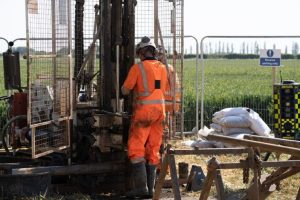
Geotechnical Engineering Limited drillers on site at Outer Dowsing performing a ground investigationAn ecological desk study was carried out by the client during the mobilisation period, to understand any ecological constraints. It was identified during the planning phase that ecological constraints were likely to be present across the site, which were accommodated into the programme of works to ensure no delays. The presence of such constraints required the project programme to be adapted to comply with the need to avoid certain areas through the initial phase of site works, to allow for detailed ecological surveys to be completed. The programme also required an element of flexibility, pending the outcome of the surveys, which was managed effectively between the integrated project team.

After overcoming the access challenges of the site. A range of drilling techniques including cable percussive drilling, dynamic sampling and rotary coring with biodegradable polymer flush media were utilised, to obtain high quality samples including high volumes of Class 1 subsamples. The boreholes were advanced to the target depths as specified by the client.

The boreholes encountered a range of different geologies that spanned the length of the linear site, from the Burnham Chalk Formation along the east coast to the Oxford Clay Formation west of Boston.

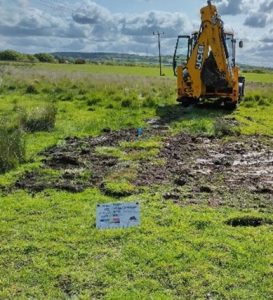
The machine excavated trial pits were sufficiently benched to facilitate in-situ readings of soil temperature, pH, thermal resistivity, and redox potential at specified depths in addition to electrical resistivity by the Wenner Array method at surface.

Water level loggers were installed in the groundwater monitoring standpipes upon completion of selected boreholes to ensure daily groundwater readings and improve efficiencies by reallocating resources that otherwise would be travelling across the site to complete manual readings.
Swansea Substation

Geotechnical Engineering Ltd employed to undertake a ground investigation to provide data to assist with the design of equipment foundations for Swansea Greener Grid Park projectTHE PROJECT

GEL were employed to undertake a ground investigation to provide data to assist with the design of equipment foundations for Swansea Greener Grid Park project; specifically involving alterations to an existing, large substation.

The projects aim was to help achieve zero carbon emissions in Wales by increasing the stability of the electricity grid and the amount of renewable energy being delivered to the grid network by the installation of large electrical machines with flywheels (called synchronous compensators) that replace the spinning turbines of a traditional power station but without emissions of carbon dioxide.

This required not only the installation of new equipment on the site, but also provision of new cable routes to link the facility to the network.

The investigation utilised a variety of techniques  to obtain high quality data which included dynamic sampling and rotary coring rigs, dynamic probing (DPSH), machine excavated trial pits, and Electrical Resistivity Tomography (ERT) surveys.

THE CHALLENGE

Access to the site was gained via a narrow lane which serviced a number of private properties and included a weight restricted bridge. Careful consideration of traffic movements and deliveries of plant and equipment along this lane was necessary to minimise any disruption.

The site was located predominantly in agricultural land adjacent to the main substation and access to the majority of investigation locations required passing over significant distances of soft ground, hindering access of plant and materials. The distances from access points to investigation locations meant that use of access trackway was impractical.

In order to obtain information to construct the foundations, access routes and cable runs, numerous different investigation techniques were employed, each appropriate to the end use of that particular part of the site.  This required close collaboration between our own plant and engineers, together with that of specialist sub-contractors, land owners and the Client in order to complete the investigation efficiently and effectively.

THE SOLUTION

Prior to any intrusive works, it was necessary to undertake  utility avoidance surveys of each location to ensure that they were clear of any buried services. Our team of utility surveyors ensured that any excavations could commence with confidence that no buried services were present.

In order to be able to move equipment to the investigation locations effectively and without the significant cost and inconvenience of installing trackway, GEL mobilised tracked ‘mules’. These are more commonly utilised alongside our slope climbing drilling rigs but are able to easily traverse  variations in topography and ground conditions in order to service investigations with equipment and materials.

The investigation utilised a variety of techniques  to obtain high quality data which included dynamic sampling and rotary coring rigs, dynamic probing (DPSH), machine excavated trial pits, and Electrical Resistivity Tomography (ERT) surveys.

Access along the lane to the site was managed by co-ordinating deliveries of plant, equipment and materials to minimise disruption and by ensuring all staff were aware of the issues from daily site briefings and signage placed along the lane. Plant deliveries were transferred from large lorries to smaller vehicles at a point prior to the narrow lane to be able to gain access to the site.

Close co-ordination between various site activities was required to enable the varied investigation techniques to work simultaneously, thereby managing the site time efficiently and effectively.

Uxbridge Moor Substation

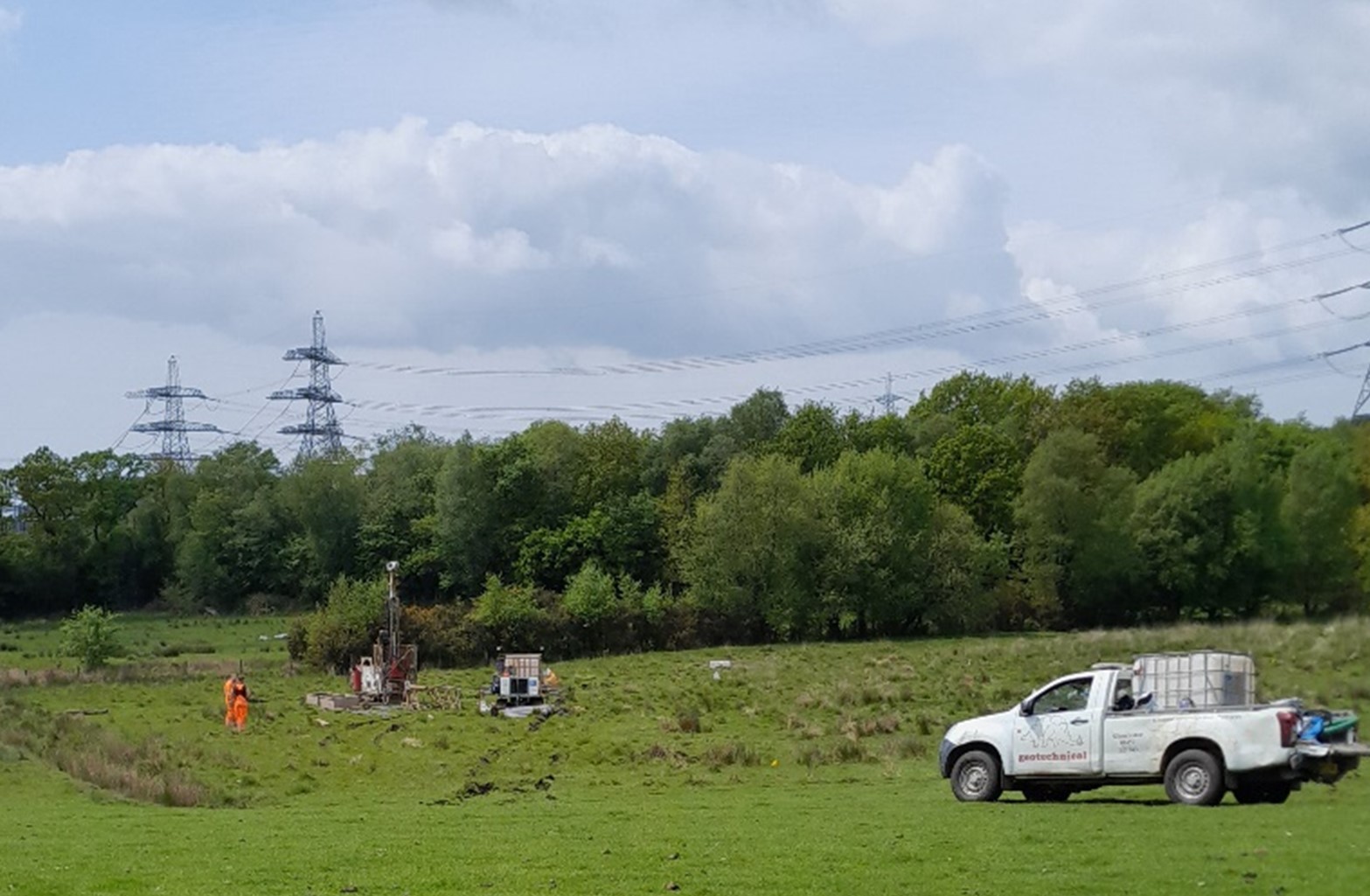
Geotechnical Engineering Limited drilling rig on site for a proposed substation at Uxbridge Moor THE PROJECT

National Grid is required to construct power transmission infrastructure to meet local connection demand in the Iver area. Given the limited room for additional equipment at the existing Iver substation, a new substation location has been proposed by National Grid in the agricultural fields adjacent.

As part of the data collection surveys to inform the design of the development of the new Uxbridge Moor substation, a ground investigation was required to provide information to assess the geotechnical, geo-environmental, geological and hydrogeological ground conditions at the proposed location.

Geotechnical Engineering Limited (GEL) was appointed by Jacobs to undertake a programme of rotary drilling works and trial pitting, soakaway testing, and thermal resistivity testing.

Jacobs was engaged by National Grid to fulfil the role as the Consultant Engineer and Principal Contractor on the project to specify the ground investigation scope and complete the subsequent design. GEL was engaged by Jacobs to undertake a programme of ground investigation for the recovery of representative samples and the installation of long-term ground water monitoring equipment.

THE CHALLENGE

Acquiring the proposed geotechnical and geoenvironmental data to aid design was likely to prove logistically challenging given the non-secure, agricultural environment to be encountered. Minimising the damage to the underfoot conditions was a critical aspect of the scheme, to mitigate any long-term impact to the landowners and cost to the client. Extensive periods of inclement weather further added to the challenge, immediately prior to the commencement of the site works. Given the proximity to Iver Substation, high voltage overhead cabling was present in proximity to a significant quantity of the exploratory positions.

THE SOLUTION

To ensure all stakeholders were informed and the scope and quantity of equipment to be used was understood, significant engagement between the landowner, tenant farmer and consultant was undertaken prior to the mobilisation of staff and equipment to site. Regular progress meetings were utilised as a conduit to portray the project progress, sequencing of the works and any changes to the programme order to all stakeholders. Arrangements were made by the client for a member of the tenant farmer’s team to be present during the works to assist with accessing the site, managing the livestock movements, and providing local knowledge of suitable access routes.

To overcome the challenging access constraints, additional support resource in the form of an operated tractor and 10,000 litre water bowser, alongside an operated all terrain telehandler were provided for the duration of the works. This allowance was critical to the timely delivery of the project deliverables, allowing our highly qualified drilling staff to focus solely on the ground investigation activities, and allow ancillary support activities to be completed without delaying the project programme. Utilising mechanical aids to mobilise heavy drilling equipment to and between each exploratory location across rough ground also reduced the risk of manual handling related injuries.

Geotechnical Engineering Limited (GEL) was appointed by Jacobs to undertake a programme of rotary drilling works and trial pitting, soakaway testing, and thermal resistivity testing.After overcoming the access challenges associated with the site, nine exploratory boreholes were completed using a Comacchio GEO 305 (Pioneer) multipurpose drilling rig.  A range of drilling techniques including dynamic sampling, and rotary coring with biodegradable polymer flush media were utilised. The boreholes were advanced to the target depths of between 8.65m and 10.05m, encountering superficial deposits of alluvium and gravels, overlying London Clay.

Geotechnical Laboratory testing (geotechnical and geoenvironmental) was undertaken by GEL and incorporated within a factual report along with the borehole and trial pit logs and thermal resistivity testing results.

Maintaining statutory distances from the high voltage overhead lines was essential to ensure the safety of our staff during the works. During the initial planning of the works, borehole and excavations positions were adjusted to ensure that the exclusion zones as required by the Energy Networks Association and GS6 guidance note ‘Avoiding danger from overhead power lines’ were adhered to at all times, documented in the safe system of work and communicated effectively to site staff.

Contact us

Centurion House, Olympus Park, Quedgeley, Gloucester GL2 4NF

Jactin House, 24 Hood Street, Ancoats, Manchester, M4 6WX

Send us a message