Site Investigation for Proposed Windfarm Development in North Scotland
The area of interest for this Geotechnical Survey is in the county of Caithness, mainland Scotland, and survey efforts focused along the approximately 25km onshore cable corridor and onshore substation location.
The aim of this investigation was to provide site specific geotechnical data for cable engineering activities. This includes Horizontal Directional Drilling (HDD) at river and rail crossings, Transition Joint Bay (TJB) excavations and cable burial activities. The data will also be used for characterisation, geoenvironmental assessment, preliminary dimensioning and foundation Screening studies. The objectives of the Onshore Geotechnical Ground Investigation are to provide onshore surface and sub-surface ground conditions to support route selection and refinement as well as aid the definition of areas of interest, determine soil classification, geoenvironmental characterisation and engineering properties, ascertain the level of difficulty of ground excavation along the route and at the substation location, and to establish soil characterisation and parameters for HDD design at the river and rail crossings.

Image 1. Highland cow in the vicinity of the job site.
Geotechnical Engineering Ltd were appointed as the Principal Contractor to undertake a suite of window sampled, sonic and rotary cored boreholes, trial pits, in situ testing, groundwater testing, monitoring and geotechnical and geoenvironmental laboratory testing.
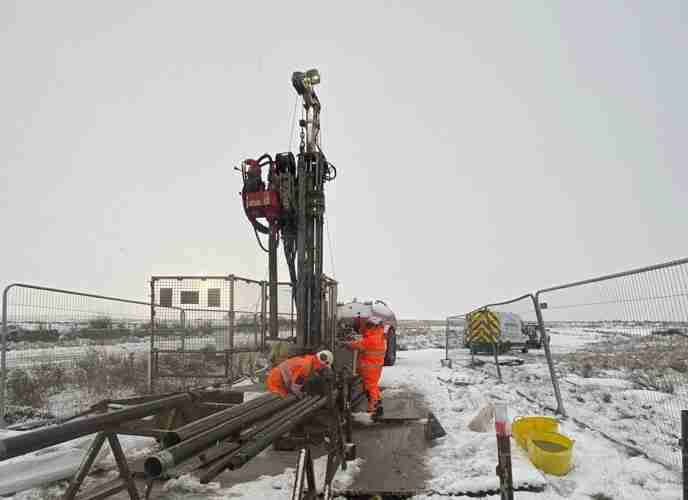
Boreholes were completed employing a combination of dynamic sampling and rotary coring techniques, whilst further boreholes were drilled using window sampling methods facilitated by a Terrier rig.
Sonic boreholes were successfully drilled by a specialist contractor selected for their proven expertise in sonic drilling methodologies. The sonic technique was chosen for its efficiency in penetrating varied strata and its ability to retrieve continuous, minimally disturbed core samples.
Trial pits were excavated using a mechanical excavator. This method allowed direct visual inspection of near-surface ground conditions and to facilitate the collection of representative soil samples for geotechnical and environmental assessment.

Image 2. Rotary rig set-up
Despite an initially high risk of interface with livestock, the project benefited from consistently positive engagement with the landowners, which helped ensure that all borehole and trial pit locations remained safe and accessible throughout.
Work areas were maintained to high safety standards using Heras fencing and PID 360 security systems. These measures ensured controlled access throughout the investigation phase. Robust fencing was constructed around borehole installations to provide long-term protection against potential interference from livestock, ensuring site integrity and safety throughout the monitoring period.
Groundwater monitoring involved retrieving data from a downhole Diver datalogger installed within designated monitoring pipes. In accordance with project specifications, additional monitoring was conducted using a Diver datalogger positioned to record stream water levels. To support stream monitoring, a purpose-built bridge and stilling tube were installed, allowing safe access and reliable data collection from the flowing watercourse.

Image 3. Bridge and stilling tube constructed to provide access for monitoring a Diver datalogger above a flowing stream
The project was successfully delivered within the agreed timescales, despite challenging winter conditions including cold temperatures and rugged terrain. The team adapted effectively to seasonal constraints, maintaining both progress and safety throughout. All reporting outputs were completed on schedule, reflecting a positive overall outcome.
A strong collaborative attitude was evident across all site personnel, with the GEL Site Agent providing standout leadership and consistently upholding high standards. Weekly progress meetings supported clear communication and coordination, while mitigation measures helped manage livestock interface risks. Thanks to proactive planning and teamwork, the project remained on programme and was delivered successfully.
Explore similar projects
West of Orkney Windfarm

Cropthorne STW Phase 2

Grwyne Fawr Reservoir – Dam Stability Study

The Thorpe Marsh Green Energy Hub: Battery Energy Storage System

50 Fenchurch Street Ground Investigation

Elan Valley Aqueduct – Bath Coppice Tunnels
-
Centurion House, Olympus Park
Quedgeley, Gloucester GL2 4NF - 01452 527 743
-
Jactin House, 24 Hood Street
Ancoats, Manchester, M4 6WX - 0161 327 3933
- geotech@geoeng.co.uk
- geospatial@geoeng.co.uk