Multiple Data Acquisition Techniques on Variable Ground
GEL were employed to undertake a ground investigation to provide data to assist with the design of equipment foundations for Swansea Greener Grid Park project; specifically involving alterations to an existing, large substation.
The projects aim was to help achieve zero carbon emissions in Wales by increasing the stability of the electricity grid and the amount of renewable energy being delivered to the grid network by the installation of large electrical machines with flywheels (called synchronous compensators) that replace the spinning turbines of a traditional power station but without emissions of carbon dioxide.
This required not only the installation of new equipment on the site, but also provision of new cable routes to link the facility to the network.
Prior to any intrusive works, it was necessary to undertake utility avoidance surveys of each location to ensure that they were clear of any buried services. Our team of utility surveyors ensured that any excavations could commence with confidence that no buried services were present.
In order to be able to move equipment to the investigation locations effectively and without the significant cost and inconvenience of installing trackway, GEL mobilised tracked ‘mules’. These are more commonly utilised alongside our slope climbing drilling rigs but are able to easily traverse variations in topography and ground conditions in order to service investigations with equipment and materials.

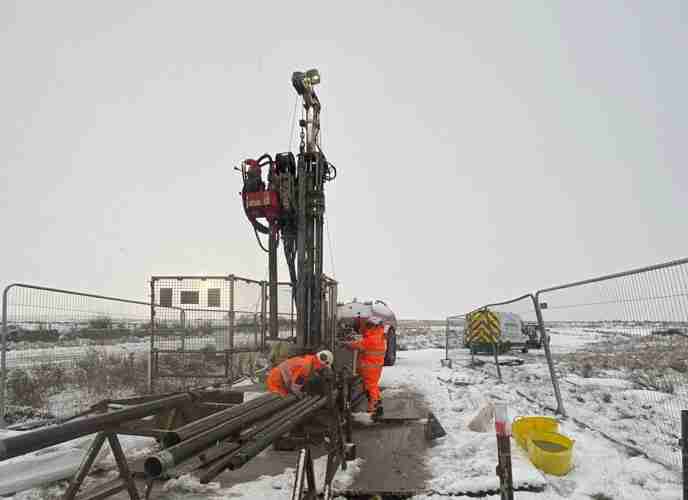
The investigation utilised a variety of techniques to obtain high quality data which included dynamic sampling and rotary coring rigs, dynamic probing (DPSH), machine excavated trial pits, and Electrical Resistivity Tomography (ERT) surveys.
Access along the lane to the site was managed by co-ordinating deliveries of plant, equipment and materials to minimise disruption and by ensuring all staff were aware of the issues from daily site briefings and signage placed along the lane. Plant deliveries were transferred from large lorries to smaller vehicles at a point prior to the narrow lane to be able to gain access to the site.
Close co-ordination between various site activities was required to enable the varied investigation techniques to work simultaneously, thereby managing the site time efficiently and effectively.
Prior to any intrusive works, it was necessary to undertake utility avoidance surveys of each location to ensure that they were clear of any buried services. Our team of utility surveyors ensured that any excavations could commence with confidence that no buried services were present.
In order to be able to move equipment to the investigation locations effectively and without the significant cost and inconvenience of installing trackway, GEL mobilised tracked ‘mules’. These are more commonly utilised alongside our slope climbing drilling rigs but are able to easily traverse variations in topography and ground conditions in order to service investigations with equipment and materials.
The investigation utilised a variety of techniques to obtain high quality data which included dynamic sampling and rotary coring rigs, dynamic probing (DPSH), machine excavated trial pits, and Electrical Resistivity Tomography (ERT) surveys.
Access along the lane to the site was managed by co-ordinating deliveries of plant, equipment and materials to minimise disruption and by ensuring all staff were aware of the issues from daily site briefings and signage placed along the lane. Plant deliveries were transferred from large lorries to smaller vehicles at a point prior to the narrow lane to be able to gain access to the site.
Close co-ordination between various site activities was required to enable the varied investigation techniques to work simultaneously, thereby managing the site time efficiently and effectively.
Explore similar projects
West of Orkney Windfarm

Cropthorne STW Phase 2

Grwyne Fawr Reservoir – Dam Stability Study

The Thorpe Marsh Green Energy Hub: Battery Energy Storage System

50 Fenchurch Street Ground Investigation

Elan Valley Aqueduct – Bath Coppice Tunnels
-
Centurion House, Olympus Park
Quedgeley, Gloucester GL2 4NF - 01452 527 743
-
Jactin House, 24 Hood Street
Ancoats, Manchester, M4 6WX - 0161 327 3933
- geotech@geoeng.co.uk
- geospatial@geoeng.co.uk