Ground Investigation for a remediation project adjacent to a canal
The lock was experiencing significant leakage, mainly on the offside around the downstream gate, with additional leaks returning into the chamber after filling and emptying, particularly on the towpath side where fines were visible. Both sides of the downstream bridge and quadrants showed signs of settlement, and the offside downstream gate recess contained large open joints requiring resin injection below the overflow pipe, followed by pointing. To address the widespread leakage and likely voiding, the offside gate recess was injected horizontally from within the chamber, and the towpath‑side wall received a full grid injection. Polyurethane resin was used to fill voids and seal leaks in both lock walls and the upstream approach wall. Prior to the works, water was escaping from the chamber into the downstream approach walls and leaking back into the chamber when emptied, with additional ground sinkage and a void upstream allowing water from the pound to drain into the empty lock. Following the injection works, all identified leaks were successfully sealed.
The purpose of this project is to carry out additional remediation works to the lock chamber wall.
The Canal & River Trust fulfil the role as the Client and Consultant Engineer on the project to specify the ground investigation scope and complete the subsequent design. Geotechnical Engineering Ltd were appointed as the Principal Contractor to undertake a series of drilling works and hand dug pits.

All borehole positions were accessed from the Lockside road adjacent to the canal, where limited parking and laydown space required close coordination with the Contract Manager and Client.
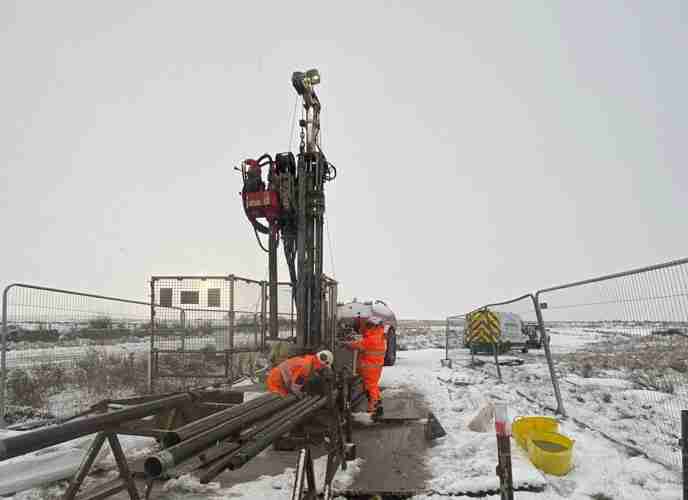
BH01 and BH02 were drilled using a rotary rig positioned just off the footpath alongside the canal. The rotary rig was selected for these locations because it provided the power, stability and reach needed for deeper drilling in relatively accessible ground, while also allowing efficient penetration through mixed superficial deposits and underlying bedrock.
Due to access constraints and concerns about potential ground subsidence at the crest of the embankment, BH03, BH04 and BH05 were completed using a modular windowless sampling rig. This lightweight, portable rig was well suited to soft or unstable ground and could be broken down into smaller components for manual transport along narrow paths and across sensitive areas. Its reduced footprint and lower ground‑bearing pressure made it the safest option for working near the embankment crest and on the restricted access route to the eastern side of the lock.
BH06 was drilled using a cut‑down Cable Percussion rig, which was compact enough to navigate the same narrow access route as BH05 while still providing sufficient drilling capability for the required depth and ground conditions.

Hand‑dug pits were excavated to expose the tops of the masonry walls and buttresses, allowing the final positions of BH03, BH04 and BH05 to be refined so that the boreholes avoided these structural elements. This ensured that drilling operations did not compromise the integrity of the lock walls while still achieving the required investigation coverage.
Samples from all exploratory hole locations were collected during the investigation and either dispatched for geoenvironmental laboratory testing or returned to our warehouse for scheduled geotechnical analysis.
All of the boreholes were completed with dual standpipe piezometers, comprising two 33 mm diameter standpipes installed within each borehole to allow independent monitoring of groundwater levels at different depths.
The site was located within a designated Coal Mining Reporting Area, which meant additional precautions were required throughout the investigation. The Client arranged the necessary Coal Authority Permit, and all drilling activities were carried out under strict gas‑monitoring procedures, with gas detectors positioned rig‑side at all times. Due to the potential for encountering mine gases, the use of air‑mist flushing was prohibited, and drilling methods were selected accordingly to ensure safe operation.
The works also involved regular vehicle and plant movements in close proximity to live traffic, requiring careful coordination, banksman support, and clear segregation between the work area and the roadway. There was also the potential for interaction with pedestrians and local residents using the towpath and surrounding public areas, so controlled access, signage, and communication measures were implemented to maintain safety and minimise disruption.
In addition, the team was working directly adjacent to water, which introduced further safety considerations. All site personnel were required to wear lifejackets while operating near the canal edge, and appropriate edge protection was installed to reduce the risk of falls into the water.
Overall, the combination of varied drilling techniques, careful rig selection, detailed structural avoidance measures, and strict safety controls, particularly in relation to mining legacy risks, public interface and waterside working, ensured that high‑quality ground data was obtained without compromising the integrity of the lock or the safety of personnel.
Explore similar projects
West of Orkney Windfarm

Cropthorne STW Phase 2

Grwyne Fawr Reservoir – Dam Stability Study

The Thorpe Marsh Green Energy Hub: Battery Energy Storage System

50 Fenchurch Street Ground Investigation

Elan Valley Aqueduct – Bath Coppice Tunnels
-
Centurion House, Olympus Park
Quedgeley, Gloucester GL2 4NF - 01452 527 743
-
Jactin House, 24 Hood Street
Ancoats, Manchester, M4 6WX - 0161 327 3933
- geotech@geoeng.co.uk
- geospatial@geoeng.co.uk